Atlas Mountains
North African mountain range separating Sahara from Mediterranean and Atlantic.

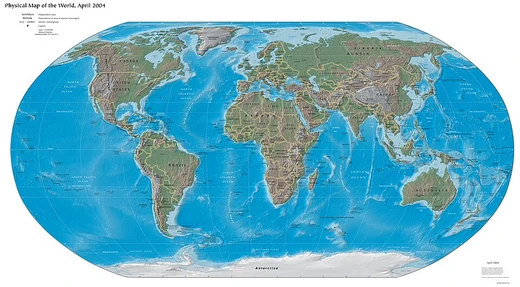
The Atlas Mountains are a mountain range in the Maghreb of North Africa, stretching approximately 2,500 km through Morocco, Algeria, and Tunisia. The range is named after the Titan Atlas from Greek mythology, and the Berber words for 'mountain'—Adrar and adras—are believed to be cognates of the toponym Atlas.
- location
- North Africa (Morocco, Algeria, Tunisia)
- length
- Approximately 2,500 km (1,600 mi)
- primary_inhabitants
- Berber populations
- geological_formation
- Three phases: Paleozoic, Mesozoic, and Paleogene/Neogene
- natural_resources
- Iron ore, lead ore, copper, silver, mercury, rock salt, phosphate, marble, anthr
Lore & Background
The Atlas Mountains were formed during three geological phases. However, geologists note a lack of evidence for subduction or significant crustal thickening, and recent studies suggest deep mantle processes may have contributed to the uplift of the High and Middle Atlas.
Reader's Guide
The Atlas Mountains are significant as a major geographic and ecological barrier in North Africa, separating the Sahara from the Mediterranean and Atlantic. They are rich in natural resources, including iron ore, lead, copper, silver, mercury, rock salt, phosphate, marble, anthracite coal, and natural gas. The range is divided into four subranges: Anti-Atlas, High Atlas, Middle Atlas, Tell Atlas, and Aurès Mountains. The mountains are home to diverse flora and fauna, including the Barbary macaque, Barbary leopard, and Barbary stag, though several species such as the Atlas bear and Barbary lion are extinct in the wild. The Berber population has historically inhabited the region, and the mountains' weather is generally cool with sunny summers and an average temperature of 25 °C. The range's geological history involves complex tectonic processes, including continental collisions and rifting, with ongoing debate about the role of mantle processes in its uplift.
Did You Know?
- The Atlas Mountains are named after the Titan Atlas from Greek mythology.
- The Berber words for 'mountain'—Adrar and adras—are believed to be cognates of the toponym Atlas.
- The first phase of the Atlas Mountains' formation, in the Paleozoic Era (~300 million years ago), was part of the Alleghenian orogeny when Africa and America were connected.
- Several species such as the Atlas bear and Barbary lion are extinct in the wild in the Atlas Mountains.
Frequently Asked Questions
Where are the Atlas Mountains located and what do they separate?
The Atlas Mountains run across the Maghreb region of North Africa, threading through Morocco, Algeria, and Tunisia. They act as a natural dividing line between the Sahara Desert to the south and the Mediterranean Sea and Atlantic Ocean to the north.
What is the highest peak in the Atlas Mountains?
Mount Toubkal, at 4,167 meters (13,671 feet), is the tallest summit in the range and also the highest point in all of North Africa. It is situated in Morocco.
How long is the Atlas Mountains range?
The range stretches for roughly 2,500 kilometers (about 1,600 miles) across three countries, making it one of the longest continuous mountain systems on the African continent.
Who are the primary inhabitants of the Atlas Mountains?
Berber (Amazigh) communities have called the Atlas Mountains home for centuries and remain the dominant population across the range. Their languages, Adrar and adras, are even believed to be linguistic roots of the range's very name.
Why is the mountain range called 'Atlas'?
The name is traditionally linked to the Titan Atlas from Greek mythology, the figure said to hold up the sky. However, the Berber words for 'mountain'—Adrar and adras—are considered cognates of 'Atlas,' suggesting the toponym may have predated any Greek connection.
More in Mountains And Mountain Ranges 1-24
Elsewhere in the Mountains And Mountain Ranges universe
Spotted an error? Know more?
This is a living reference — every entry is fact-audited, and reader corrections feed straight into our audit queue. Suggest an edit · See this site's audit record